
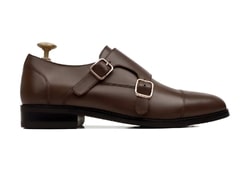
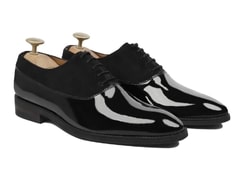
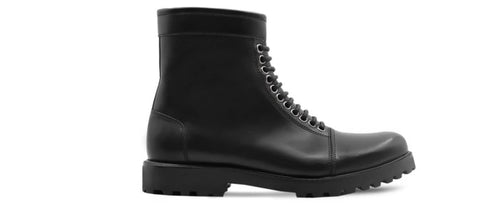
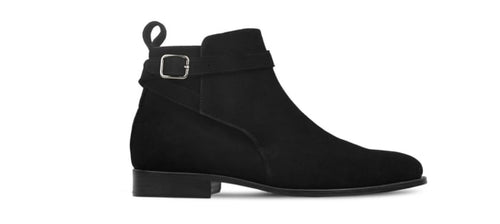


How should dress shoes fit? They should feel secure through the heel and instep, comfortable across the widest part of the foot, and roomy enough at the toes that your toes are not pressed or curled. A new pair can feel firm, but it should not feel painfully tight or depend on heavy stretching to become wearable.
Quick answer: A well-fitting dress shoe should hold the heel with minimal movement, support the midfoot without pressure points, and leave a small amount of room in front of the longest toe. Your foot should not slide forward, your toes should not touch the end, and the shoe should not pinch across the ball of the foot.
Dress shoes usually feel more structured than sneakers, so the first wear can feel different. The goal is not a loose, slipper-like fit. It is a secure fit that stays comfortable when you stand, walk, and bend the foot.
Where should dress shoes feel snug?
Dress shoes should feel snug around the heel, instep, and sides of the midfoot. Those areas help keep the foot stable inside the shoe.
Snug does not mean painful. You should not feel sharp pressure, numbness, or a strong squeezing sensation. A structured leather upper may soften with wear, but a shoe that is clearly too narrow or too short is unlikely to become the right size through break-in alone.
How much toe room should dress shoes have?
Your longest toe should not touch the front of the shoe. There should be enough room to move the toes naturally without the foot sliding around.
The exact space in front of the toes varies because dress-shoe shapes differ. A long, tapered Oxford can have more empty space at the front than a rounded Derby even when both fit correctly. That is why toe-box pressure matters more than judging fit only by the visible length of the shoe.
If you need extra room through the forefoot rather than extra shoe length, compare our men's wide toe box dress shoes. Selected made-to-order styles can be requested with a wider forefoot fit.
How should the ball of the foot fit?
The widest part of your foot should sit close to the widest part of the shoe. This is one of the most useful fit checks because it affects comfort, flex, and how naturally the shoe bends while walking.
If the ball of the foot sits too far forward or too far back, the shoe may crease in the wrong place or feel unstable. If the sides feel squeezed at the widest point, the shoe may be too narrow even if the length seems correct.
How much heel slip is normal?
A very small amount of heel movement can happen in a new pair of dress shoes, especially before the sole begins to flex naturally. Repeated lifting, rubbing, or obvious slipping is a sign that the fit may be too loose.
The heel should feel held when you walk. If you have to grip with your toes to keep the shoe on, the shoe is not secure enough.
Should dress shoes feel tight when new?
They can feel firm, but they should not feel painfully tight. New leather often softens and becomes more flexible, especially around the upper and flex points, but length does not meaningfully increase.
A shoe that is slightly stiff is normal. A shoe that crushes the toes, causes strong side pressure, or becomes uncomfortable after a few minutes is not a good break-in starting point.
How should Oxford shoes fit?
Oxford shoes should feel particularly secure through the instep and midfoot because their closed-lacing construction creates a more fitted upper.
The lacing area should close neatly without needing to be forced completely shut. If the shoe feels comfortable but the eyelets are pulled together under heavy tension, the volume may be too low for your foot.
A structured pair such as Marcello Sarto's Black Wholecut Oxford Shoes for Men shows why heel hold and instep fit matter: the clean, close-fitting upper leaves less room for a loose fit to hide.

How should Derby shoes fit?
Derby shoes use open lacing, so they usually allow a little more adjustment across the instep than Oxfords. The basic fit rules are still the same: secure heel, comfortable width, correct flex point, and no toe pressure.
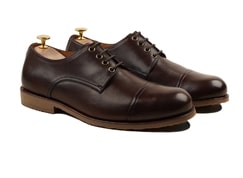
If you have a higher instep or prefer a little more adjustability, a Derby can sometimes feel easier to dial in. Marcello Sarto's Brown Smooth Leather Derby Shoes for Men are an example of the open-lace construction.

What should the laces tell you about fit?
Laces are useful because they show how much adjustment the shoe needs.
| What you see | What it may mean |
|---|---|
| Laces secure with moderate tension | Usually a good sign |
| Eyelets pulled very tightly together | Shoe may have too much volume for your foot |
| Large gap with heavy pressure across instep | Shoe may be too low-volume or too narrow |
| Laces feel loose but heel still slips | Shoe may be too large or too wide |
These are clues rather than absolute rules because every last and foot shape is different.
How do you know if dress shoes are too small?
Common signs include toes touching the end, strong pressure across the sides, numbness, burning, or pain that appears quickly after walking.
Another warning sign is when the shoe feels acceptable while sitting but becomes uncomfortable as soon as you stand. Feet spread slightly under body weight, so fit should always be checked while standing and walking.
How do you know if dress shoes are too big?
Dress shoes are probably too big if the heel lifts noticeably, the foot slides forward, the shoe bends well ahead of the ball of the foot, or you need to over-tighten the laces to feel secure.
A loose dress shoe can create rubbing and instability just as easily as a tight one can create pressure.
Should your toes touch the end of dress shoes?
No. Your toes should not press against the front while standing or walking.
Remember that the front shape of a dress shoe may extend beyond the toes by design. The important question is whether the toes have comfortable space and whether the ball of the foot sits where the shoe is designed to flex.
How should dress shoes feel when walking?
Your heel should stay mostly in place, the shoe should bend with the forefoot, and your toes should remain comfortable as the foot moves forward.
Walk on a clean indoor surface before deciding. Try several normal strides, turn, and stand still for a minute. Small issues that are easy to miss while sitting often become obvious once the foot is moving.
Do leather dress shoes stretch?
Leather can soften and give slightly across pressure points, but it does not turn a clearly wrong size into the right one. Width and upper flexibility may improve a little; overall shoe length will not meaningfully change.
That is why buying a painfully tight pair with the expectation that it will stretch into comfort is risky.
What socks should you use when checking fit?
Use the type of socks you expect to wear with the shoes. A thin dress sock and a thick casual sock can change how the same shoe feels.
If the shoes are mainly for work or formal events, fit them with your normal dress socks rather than barefoot or with athletic socks.
Is afternoon a better time to try on dress shoes?
Feet can become slightly larger later in the day after standing and walking. Trying shoes when your feet are closer to their typical daytime size can help you avoid choosing a pair that feels fine in the morning but tight later.
The difference varies from person to person, so the more important rule is to try the shoes under realistic conditions and with your normal socks.
Quick dress-shoe fit checklist
- Heel feels secure with little movement.
- Toes are not touching or curled.
- The widest part of the foot sits near the widest part of the shoe.
- No sharp pressure across the instep or sides.
- Shoe bends naturally near the ball of the foot.
- Laces secure the shoe without extreme tension.
- You can walk normally without gripping with your toes.
How is dress-shoe fit different from loafer fit?
Lace-up dress shoes can be adjusted across the instep, while loafers depend more heavily on the shape of the upper to hold the foot. That makes heel and instep fit especially important in slip-on shoes.
If you are sizing loafers specifically, our how should loafers fit guide covers heel slip, instep hold, and penny-loafer fit in more detail.
The simplest rule to remember
If you are asking how should dress shoes fit, look for secure rather than tight. The heel should stay controlled, the widest part of the foot should sit comfortably in the widest part of the shoe, and the toes should have room without the foot sliding forward.
If you are buying online and comparing sizes before ordering, our shoe sizing guide for online purchases explains how to measure and compare size information. You can also browse Marcello Sarto's Men’s Oxford Shoes & Wingtips to compare different dress-shoe shapes.