


How should loafers fit? The short answer is snug, secure, and comfortable without feeling tight. Because loafers do not have laces to pull the shoe onto your foot, the fit has to come from the shape of the upper itself. If the heel lifts too much or the instep feels loose, the shoe can feel unstable even when the length looks correct.
That is what makes loafer sizing a little different from buying Oxfords, Derbies, or boots. With a lace-up shoe, you can make small adjustments at the top of the foot. With a loafer, you have much less room to correct a poor fit after the fact.
The goal is not to find the tightest pair you can tolerate. It is to find a pair that holds your foot securely without creating pressure points.
Your Heel Should Feel Secure, Not Locked in Place
A small amount of heel movement can happen in a new loafer, especially before the sole has started flexing naturally. What you do not want is obvious slipping every time you take a step.
If your heel is lifting high enough that you feel the shoe coming off the back of your foot, the loafer is probably too loose in the heel, too large overall, or simply the wrong shape for your foot.
Do not assume a heel pad will solve a major fit problem. It can fine-tune a slightly loose shoe, but it should not be used to rescue a pair that is clearly too big.
The Instep Is Where a Loafer Really Holds Your Foot
The most important part of loafer fit is often the area across the top of the foot.
Since there are no laces, the vamp has to hold your instep securely enough to stop the foot sliding forward. A good fit should feel close and supportive here, but not painful.
If you can feel your foot moving forward and backward inside the shoe, the instep may be too loose. If the upper digs sharply into the top of your foot, it may be too shallow or simply too tight.
This is one reason the same size can fit differently across penny loafers, tassel loafers, horsebit loafers, and softer moccasin-style shoes. The shape of the upper changes how the shoe grips your foot.
Your Toes Need Room Even If the Shoe Feels Snug Elsewhere
A secure loafer should not crush your toes.
Your toes should be able to lie naturally without curling, pinching, or rubbing against the front or sides. The shoe can feel close around the heel and instep while still giving the forefoot enough room.
Do not size down just to eliminate every trace of heel movement if that forces the toes into the front of the shoe.
Length and volume are different things. A loafer can be long enough but still too tight across the ball of the foot, or wide enough while being too long.
The Widest Part of Your Foot Should Sit in the Widest Part of the Shoe
This is one of the easiest fit checks to miss.
The ball of your foot should line up with the widest part of the loafer. If it sits too far forward or too far back, the shoe may crease strangely, feel stiff when walking, or create pressure where the shoe was not designed to flex.
When you try the pair on, take a few slow steps and notice where the shoe bends. The natural flex point should be close to the ball of your foot, not halfway under your toes.
Should Loafers Feel Tight When New?
They can feel snug, but they should not feel painful.
Leather uppers can soften and relax slightly with wear, but that does not mean you should buy a pair that already feels too small. A painful pressure point rarely turns into a perfect fit simply because the leather is good quality.
What can change is the way the upper settles around the foot and the way the sole begins to flex. That often makes a correctly sized pair feel more natural after several wears.
If you are deciding between “firm but comfortable” and “tight enough to hurt,” choose the first one.
Leather and Suede Do Not Break In Exactly the Same Way
Smooth leather loafers often start with a more structured feel, especially around the vamp and heel. Over time, the upper can soften and take on more of the shape of your foot.
Suede usually feels softer from the beginning, but that does not mean the fit should start loose. A suede loafer that already feels sloppy on day one can become even less secure after wear.
So the material changes the feel, but the rule stays the same: your foot should be held securely before the shoe has fully broken in.

If you are comparing materials, the full-grain leather vs suede guide explains the practical differences between the two.
Penny, Tassel, and Horsebit Loafers Can Fit Differently
The name on the shoe does not determine the fit by itself, but different designs can change how the upper sits across your foot.
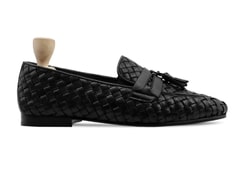
A classic penny loafer usually has a clean vamp and strap across the top, while tassel and horsebit designs can use slightly different cuts and construction around the instep.
Marcello Sarto's Brown Patina Penny Loafers for Men are a traditional penny-loafer example, while the Brown Smooth Leather Horsebit Moccasins use a softer moccasin-style shape.

The important point is to judge the fit of the actual pair rather than assuming every loafer in the same numerical size will feel identical.
Socks Can Change the Fit More Than You Expect
Try loafers with the type of socks you actually plan to wear.
A pair that feels perfect with thin dress socks may feel cramped with thicker casual socks. A pair that feels secure with normal socks may become loose with no-show socks.
If you plan to wear the shoes mostly with tailoring, test them with dress socks. If they are mainly for chinos or summer outfits, use the no-show socks you normally wear.
This gives you a more realistic idea of fit than trying them barefoot and guessing.
What Heel Slip Is Normal?
A tiny amount of movement can be normal in a new pair, particularly before the sole has softened. The issue is the amount.
If your heel lifts slightly but the shoe still feels controlled, that may settle as the sole begins to flex. If the heel is visibly popping out or you have to curl your toes to keep the shoe on, that is too much movement.
Do not confuse “the sole is still stiff” with “the shoe is the wrong size.” Walk on a clean indoor surface and pay attention to whether the whole shoe moves with your foot or your foot is sliding independently inside it.
Signs Your Loafers Are Too Big
- Your heel lifts noticeably with every step.
- Your foot slides forward inside the shoe.
- You need to grip with your toes to keep the loafer on.
- The vamp feels loose or forms large empty folds.
- The flex point of the shoe sits well ahead of the ball of your foot.
One of these signs on its own does not always prove the size is wrong, but several together usually mean the fit is too loose.
Signs Your Loafers Are Too Small
- Your toes press against the front or sides.
- The widest part of your foot feels pinched.
- The instep pressure is sharp rather than simply snug.
- You feel numbness, burning, or persistent rubbing after a short indoor test.
- The shoe feels uncomfortable before you have even started walking normally.
Do not rely on break-in to fix these problems. Leather can soften, but it does not magically create the extra length or volume a genuinely undersized shoe needs.
A Simple At-Home Fit Test
When trying on a new pair, use a clean indoor floor so the soles remain returnable if the fit is wrong.
Stand naturally first. Check that your toes are comfortable and that the ball of the foot sits near the widest point of the shoe. Then walk for several minutes at a normal pace.
Notice three things: whether the heel stays controlled, whether the instep holds the foot without pain, and whether the toes have enough room when the shoe bends.
Do not judge the pair only while sitting down. A loafer can feel fine at rest and become obviously wrong as soon as your foot starts moving inside it.

Do Not Automatically Size Down in Loafers
You will often hear that loafers should always be bought half a size smaller. That is too simple.
Some lasts are generous, some are narrow, and some have more room over the instep. Your own foot shape matters just as much.
The safest approach is to use the brand's size guidance and compare it with a shoe you already know fits well. Our online shoe sizing guide covers that broader measurement process.
For loafers specifically, the final decision should come from heel security, instep hold, toe room, and flex point — not from a rule that every person should size down.
Fit Matters More Than the Loafer Style
A beautiful loafer that slips off your heel or pinches your toes is not a useful shoe.
Whether you choose penny, tassel, suede, or horsebit styles, the same basic fit test applies: the heel should be controlled, the instep should feel secure, the forefoot should not be squeezed, and the shoe should flex where your foot naturally bends.
That is the practical answer to how should loafers fit: close enough to stay with your foot, comfortable enough that you are not waiting for pain to disappear.
If you want to compare different loafer shapes before choosing a pair, browse Marcello Sarto's Men’s Loafers & Slip-Ons collection or read our men’s leather loafers guide.