


Seamless wholecut shoes are built from a single continuous piece of leather across the entire upper, with no seams joining separate panels the way an oxford or derby has — genuinely the most minimalist, formal silhouette in men's dress footwear. Here's what makes them different, and why they're harder to make well than they might look.
Why "Simple" Doesn't Mean "Easy to Make"
This is honestly the part I find most interesting about wholecuts. Because there are no seams to hide small imperfections in the leather, a wholecut shoe demands a genuinely flawless piece of hide, cut and shaped with real precision. Any inconsistency in the leather is visible immediately, in a way a paneled shoe can sometimes disguise. That's exactly why wholecuts are considered one of the harder shoes to produce well, despite looking like the simplest.
What Makes a Wholecut Different
A standard oxford or derby is assembled from multiple leather panels stitched together — a vamp, quarters, sometimes a toe cap. A wholecut skips all of that, using one uninterrupted piece of leather molded over the last. The only stitching you'll see is at the closed lacing and the sole attachment — nothing across the upper itself.

How Formal Is a Wholecut, Really?
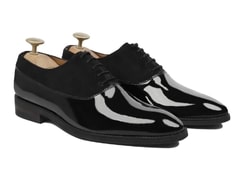
About as formal as it gets. A plain black wholecut oxford sits at or near the top of the formality scale, right alongside a plain captoe oxford, appropriate for black-tie events and the most conservative business settings. The clean, unbroken silhouette is exactly why it reads as so formal — there's genuinely nothing to distract from the shape of the shoe itself.
What to Look For in Construction Quality
A single, high-quality piece of leather with no visible flaws — given there's nowhere for imperfections to hide, this matters more here than on almost any other style.
Clean, even lacing stitching, since it's one of the only visible construction details on the entire shoe.
Stitched sole construction, ideally Goodyear welt or Blake stitch, for durability and resoling ability.
Color and Finish Options
Black remains the most traditional and formal choice. But wholecuts also work well in more distinctive finishes — a washed or delave leather adds subtle texture without breaking the seamless silhouette, and bolder tones like gold can turn the style into a genuine evening statement piece rather than a strictly conservative choice.
How to Style Wholecut Shoes
With a formal suit or tuxedo, a black wholecut is about as safe and correct a choice as exists in men's footwear. For something more distinctive, a colored or washed-leather wholecut works well with a well-fitted suit where you want the shoe itself to carry some visual interest.
Frequently Asked Questions
Are wholecut shoes more formal than a captoe oxford?
They're comparable, both sitting at the top of the formality scale — the wholecut's completely unbroken silhouette is sometimes considered marginally more formal due to its extreme simplicity.
Why are wholecut shoes considered difficult to make?
Because there are no seams to hide imperfections in the leather, the entire upper needs a flawless piece of hide, cut and shaped with real precision.
Are wholecuts appropriate for everyday business wear?
Yes, particularly in black, though their minimal design is genuinely at its best in the most formal settings rather than everyday use.
Browse our full range of handmade wholecut shoes in our Oxford & Wingtips collection.
See a featured pair: Blue Delave Calfskin Wholecut Shoes for Men.