


Black oxford shoes are the single most versatile formal shoe a man can own — the most conservative, most universally appropriate choice in men's footwear, working for business meetings, weddings, funerals, and everything in between without ever being the wrong call. I think exactly because it's so foundational, it's worth actually understanding what separates a genuinely well-made pair from an ordinary one, rather than just grabbing whatever looks shiny enough.
What Actually Defines an Oxford
The oxford's defining feature is closed lacing — the eyelet tabs are stitched underneath the vamp (the front panel), which pulls the shoe tightly closed and creates that sleek, low-profile silhouette everyone recognizes. This is different from a derby, where the eyelet tabs sit on top of the vamp instead. That closed construction is genuinely what gives the oxford its reputation as the most formal lace-up shoe style, not just tradition for its own sake.
If forefoot space is a priority, remember that closed lacing does not automatically mean a narrow toe box. Selected made-to-order styles with extra forefoot room can be compared in our men's wide toe box dress shoes collection.
The Main Oxford Styles, by Formality
Plain captoe oxford — a clean toe cap seam with no perforation or decoration. The most versatile option, appropriate for nearly any formal or business occasion, and honestly the safest first purchase you can make.
Wingtip brogue oxford — perforated, W-shaped toe cap detailing. Slightly less formal than a plain captoe, works well for business and business-casual settings, less ideal for black-tie.

Wholecut oxford — built from a single, seamless piece of leather. The most minimal and formal version out there, traditionally reserved for the most important occasions. I get into what actually makes this construction so distinctive in our guide to seamless wholecut shoes.
Semi-brogue oxford — partial perforation, a genuine middle ground between plain and full wingtip detailing.
What I'd Actually Look For in Construction Quality
Genuine full-grain leather, clearly specified rather than vague "leather" language — full-grain develops a richer patina with wear and holds up noticeably better over years of use.
Stitched sole construction, ideally Goodyear welt or Blake stitch rather than glued assembly, since this determines both durability and whether the shoe can actually be resoled down the line. For more on identifying genuine Goodyear welt construction, see our buying guide.
Clean, even stitching throughout, particularly around the closed lacing system and any toe cap seam. This is genuinely where construction quality shows most clearly on a plain black oxford, since there's so little decoration to distract from it.
A properly cushioned insole and quality lining, since black oxfords tend to see more regular wear than almost any other formal shoe in a wardrobe.
Black Leather Finishes Worth Knowing
Smooth polished leather — the standard, most formal finish, takes a high shine and works for virtually any formal occasion.
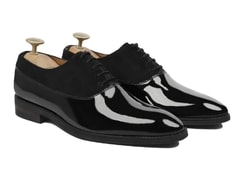
Patent leather — an extremely glossy finish reserved specifically for black-tie and the most formal evening events; genuinely too formal for everyday business wear.
Suede — a real departure texture-wise, shifting the oxford toward smart-casual rather than strict business formal.
How to Style Black Oxford Shoes
With a business suit, it's the default, foolproof pairing for nearly any professional setting. With formal evening wear, a plain captoe or wholecut oxford works for black-tie when patent leather isn't available or preferred. And for sock coordination, dark socks matching your trouser color keep the leg line clean and formal — I'd avoid bright or patterned socks with the most conservative black oxford styling.
How Many Pairs Do You Actually Need
For most men, one exceptional pair of black captoe oxfords, properly cared for and resoled as needed, can serve as a primary formal shoe for years. If you're building out a broader formal wardrobe, a black oxford is genuinely the foundation you add other colors and styles around — our derby and monk strap comparison is a good next stop.
Frequently Asked Questions
Are black oxfords appropriate for every formal occasion?
Yes, with one caveat — patent leather specifically is reserved for black-tie, not everyday business wear. A plain smooth-leather captoe oxford handles nearly everything else.
What's the difference between an oxford and a derby in black?
The lacing construction — oxfords have closed lacing for a sleeker, more formal silhouette; derbies have open lacing offering more room through the instep, making them slightly less formal but often more comfortable.
How long should a well-made pair of black oxfords last?
With proper care and periodic resoling, a genuinely well-constructed pair (Goodyear welted especially) can last many years, sometimes decades — well beyond what a cemented, mass-produced pair would ever survive.
Do black oxfords need to be broken in?
Yes, particularly Goodyear welted construction, which tends to be stiffer initially than glued alternatives. Expect a genuine break-in period with short wears before extended use.
Browse our full range of handmade black oxford shoes — captoe, wingtip, and wholecut styles — in our Men's Black Oxford Shoes collection.
See a featured pair: Black Leather Handmade Oxford Shoes for Men.