


Men’s dress shoes online are easy to browse and surprisingly easy to buy badly. A polished photo can make almost any pair look impressive, but the things that decide whether you will actually enjoy wearing the shoes — fit, leather, construction, shape, and return options — are not always obvious from the first image.
The good news is that online shopping gives you something a store shelf does not: time to compare details. You can look at several styles side by side, read the material description carefully, check the sole, study different angles, and decide whether the shoe fits your real wardrobe instead of making a decision under bright shop lighting in five minutes.
The goal is not to find the most dramatic pair on the page. It is to reduce the number of surprises that arrive in the box.
Decide What Job the Shoe Needs to Do
Before looking at color or price, decide where you expect to wear the shoe most often.
A shoe for a conservative office has a different job from a shoe for weddings, dinners, or smart-casual weekends. If you need one pair to handle formal meetings and dark suits, a clean black Oxford makes sense. If most of your wardrobe is navy, grey, beige, or business casual, brown can give you more combinations.
This first decision narrows the field immediately.
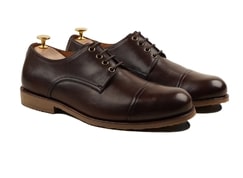
For example, Marcello Sarto's Black Leather Handmade Oxford Shoes for Men are deliberately simple and formal. A brown cap-toe Oxford, such as the Brown Leather Cap Toe Formal Oxford Shoes, gives you a warmer option without leaving traditional dress-shoe territory.
If you are not yet sure whether an Oxford is the right style, our men’s Oxford dress shoes guide explains where it sits on the formality scale.

Do Not Let the First Product Photo Make the Decision
The first image is designed to show the shoe at its best. That is useful, but it is not enough.
Look for the side profile. Look at the toe from above. Check the heel. Zoom in on the leather. If the store provides several angles, compare them before reading the marketing copy.
The side view tells you whether the shoe is sleek or bulky. The top view shows how narrow or wide the toe really is. A close image can reveal brogue work, stitching, grain, texture, and the way different panels meet.
This matters because two shoes can have the same title — “brown leather Oxford,” for example — and still create completely different silhouettes on the foot.
Read the Material Description More Carefully Than the Headline
“Leather shoe” is not a detailed description.
The useful information is underneath that label. Is the upper full-grain leather, suede, embossed leather, or something else? Is the lining leather? What is the sole made from? Is the finish smooth, hand-painted, textured, or heavily corrected?
Those details affect how the shoe looks after six months, not just how it looks on delivery day.
Smooth leather is usually easier to polish and works naturally in formal settings. Suede creates a softer, more relaxed look. Patina finishes add tonal variation, which can make a brown shoe more visually interesting but also less conservative.
If you are comparing materials, our men’s leather dress shoes guide is a better place to understand the differences than trying to judge leather quality from color alone.

The Sole Tells You How the Shoe Expects to Be Used
Online buyers often spend ten minutes studying the upper and almost no time looking at the bottom of the shoe.
That is a mistake.
A leather sole creates a traditional, slim dress-shoe profile. It can be a strong choice for offices, formal events, and indoor wear. Rubber generally gives you more traction and can make more sense if your day includes long walks, wet streets, or a lot of outdoor use.
Some shoes combine both ideas by using leather with a grip protector.
The choice is not about which material is universally better. It is about whether the sole matches your routine. Our leather sole dress shoes guide goes deeper into that trade-off.
Construction Is Worth Checking Even If You Are Not a Shoe Expert
You do not need to memorize every shoemaking term before buying online. You do need to notice whether the product page tells you how the shoe is put together.
Stitched constructions can make future repair or resoling easier, depending on the design. Blake stitching tends to create a slimmer, more flexible profile. Welted construction is often associated with a more structured build and easier resoling.
The important point is not to choose a construction because it sounds prestigious. It is to understand what you are paying for.
If the product page gives you the construction method, that is useful information. If you want the technical differences explained simply, see our comparison of Goodyear welt vs Blake stitch.
Your Usual Size Is a Starting Point, Not Proof of Fit
This is where online shoe shopping becomes personal.
A US 9 in one last can feel different from a US 9 in another. Toe shape, width, instep volume, heel shape, and the way the upper is cut all affect fit.
Do not automatically size up because a dress shoe looks narrow in the photo. Extra length can create heel slip and poor creasing without solving the real width problem.
Instead, compare the seller's size chart with a pair you already own comfortably. If measurements or international conversions are provided, use them. And if your feet sit between sizes, pay attention to the store's exchange process before ordering.
We already have a separate guide on choosing the right shoe size when buying online, so this article will not repeat the whole sizing process. The important point here is simple: never treat the number on the box as the only fit information.
The Return Policy Is Part of the Product
When you buy shoes in person, you can walk around the shop before paying. Online, the return and exchange process is what replaces that safety net.
Read it before checkout, not after the shoes arrive.
Check the return window. Check whether the shoes need to remain unworn. Check who pays return shipping. Check how size exchanges are handled. If you are ordering internationally, confirm whether there are any practical restrictions that would make a return difficult.
A good product page can answer questions about leather and construction. A clear policy answers the question of what happens if the fit is wrong.
Choose Color From Your Wardrobe, Not From the Product Page
Online stores make unusual colors look tempting because every pair is photographed in isolation.
Your wardrobe is not isolated.
Before buying burgundy, blue, tan, or a dramatic patina, think about the trousers and suits you already own. If a shoe only works with one outfit, it may spend most of its life in the box.
Black is easiest when your wardrobe is formal or built around charcoal, black, and dark navy. Medium and dark brown are usually easier with navy, grey, beige, olive, and denim.
A simple way to test the decision is to name three outfits you can wear with the shoe immediately. If you cannot, the color may be more interesting than useful.
Do Not Confuse More Detail With Better Quality
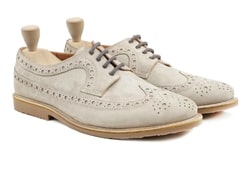
Brogue perforations, double buckles, exotic textures, and hand-painted finishes can make a shoe more distinctive. They do not automatically make it better.
A plain shoe can be excellent. A decorative shoe can be excellent. The useful question is whether the details suit the role you need the shoe to play.
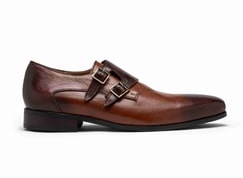
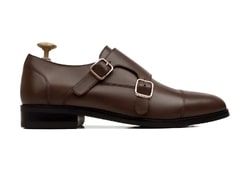
A brown double monk, for example, brings more personality than a plain Oxford and can work well in a business-casual wardrobe. Marcello Sarto's Brown Double Monk Strap Shoes for Men are a good example of a dress shoe that uses detail without moving completely into statement-shoe territory.

If you want to compare categories before choosing, browse the Men’s Oxford Shoes & Wingtips, Men’s Derby Shoes, and Men’s Monk Strap Shoes collections side by side.
Price Makes More Sense When You Compare Like With Like
Online shopping makes price comparison effortless, but it can also make it misleading.
A $150 shoe and a $300 shoe are not necessarily offering the same materials, construction, lining, sole, finishing, or production method. At the same time, a higher price does not prove better quality on its own.
Compare the specifications, not only the number beside the “Add to cart” button.
Ask what the upper is made from. Ask what the lining is. Look at the sole. Check the construction. Look at the finishing. Then compare price.
That sequence gives you a much clearer idea of value than sorting every page from cheapest to most expensive.
A 60-Second Check Before You Place the Order
Before checkout, go back through the product page once without looking at the hero image.
- Does the style match the occasions you actually dress for?
- Have you checked more than one product angle?
- Do you know the upper, lining, and sole materials?
- Have you checked the size guidance instead of relying only on your usual number?
- Do you understand the return or exchange process?
- Can you name at least three outfits you already own that work with the color?
If those answers are clear, you are making a much better decision than someone buying from the first polished photo.
Buying Dress Shoes Online Should Give You More Information, Not Less
The biggest advantage of shopping for men’s dress shoes online is not the number of products you can scroll through. It is the amount of comparison you can do before spending anything.
You can study shape, material, sole, construction, fit guidance, color, and policy at your own pace. That does not eliminate every risk — shoes still need to fit a real foot — but it turns the purchase from guesswork into a much more informed decision.
Start with the role the shoe needs to play, then work through the details. If the product still makes sense after that, it is far more likely to make sense when the box arrives.