
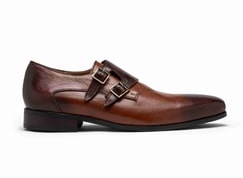
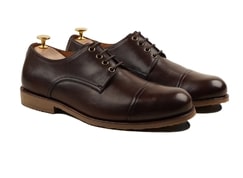
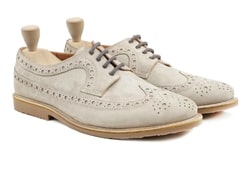
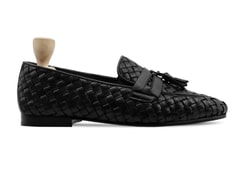


Men’s Oxford dress shoes are usually described as formal shoes, but that description only tells half the story. A plain black Oxford can belong comfortably at a black-tie event, while a brown brogued Oxford can look perfectly natural with chinos and a jacket.
They are both Oxfords.
The difference comes from everything built around the basic Oxford construction: the color, leather, toe design, brogue detailing and even the shape of the shoe.
So instead of asking whether Oxford shoes are formal, a better question is:
How formal is this particular pair?
Once you know what to look for, the answer is surprisingly easy.
The Detail That Makes an Oxford an Oxford
Ignore the color for a moment and look at the laces.
On an Oxford, the sections of leather holding the eyelets are stitched underneath the front part of the shoe. When the shoe is tied, those sections sit close together and create a clean, controlled appearance.
This is called closed lacing.
A Derby uses open lacing instead, which gives the upper a slightly more relaxed shape.
It sounds like a tiny construction difference, but visually it matters.
The closed lacing is one reason Oxfords have traditionally sat toward the formal end of men’s footwear.
If you have ever been unsure which style you are looking at, our Oxford vs Derby vs Monk Strap guide explains the difference more closely.
Think of Oxford Shoes on a Formality Scale
Rather than putting every Oxford into one category, imagine a scale.
At one end is the simplest possible shoe.
At the other is a more decorative Oxford that has been designed to feel less severe.
Plain black Oxford
This is about as formal as standard men’s dress footwear gets.
Smooth black leather, little or no decoration and a slim shape make it appropriate for dark suits, important business occasions, weddings and formal evening wear.
If you are building a formal wardrobe from scratch, this is the pair that covers the occasions where getting the footwear wrong is most noticeable.
Marcello Sarto's Black Leather Handmade Oxford Shoes for Men are a useful example of this cleaner end of the scale.

Black cap-toe Oxford
Move only slightly down the scale and you reach the cap toe.
A horizontal seam across the toe adds some visual structure without making the shoe particularly decorative.
That is why black cap-toe Oxfords have become such a dependable business shoe.
They are polished enough for serious tailoring but slightly less severe than a completely plain Oxford.
There is already a dedicated guide to captoe Oxford shoes on Marcello Sarto, so we will not turn this article into another cap-toe buying guide.
Brown Oxford
Changing from black to brown has a bigger effect than many men expect.
The shoe can have the same clean construction, but brown immediately makes it easier to combine with navy, grey, beige and more relaxed tailoring.
Dark brown can still look very polished.
Medium and lighter browns gradually move into smart-casual territory.
This is where Oxford shoes for men become far more useful outside purely formal events.

Brogue Oxford
Now add perforated detailing.
The more broguing you add, the less severe the shoe tends to look.
A small amount around the toe cap can still work comfortably with a suit. A full wingtip with extensive perforation has much more personality and usually feels more at home with textured tailoring, chinos or smart denim.
That does not mean brogues are casual shoes.
It means the decoration shifts the balance.
If you want to go deeper into that distinction, see how to wear brogue shoes.
Wholecut Oxford
Then there is the unusual exception.
A wholecut Oxford can actually become more formal by removing detail.
Instead of several leather panels, the upper is made from a very minimal piece of leather with fewer visible seams.
That creates an exceptionally clean surface.
Our guide to seamless wholecut shoes explains why producing that simplicity is harder than it looks.
Your Suit Does Not Automatically Require Black Shoes
This is where men often make the decision harder than necessary.
The suit color matters.
A charcoal or very dark suit worn to a serious formal event naturally points toward men's black Oxford shoes.
But navy opens up more options.
A navy suit with dark brown Oxfords can still look polished while feeling slightly warmer and less corporate.
Medium grey works with both.
For lighter tailoring, especially in warm weather, brown often feels more natural than black.
You can think about it this way:
The darker and more serious the outfit becomes, the stronger the case for a simple dark Oxford.
As the outfit becomes lighter, softer or more textured, you gain room to use brown leather, patina and brogue detailing.
That is much more useful than memorizing dozens of rigid shoe rules.
What About Weddings?
Oxfords are one of the safest wedding shoe choices because they can adapt to very different levels of formality.
For a traditional groom in a black, charcoal or very dark navy suit, a polished black Oxford is difficult to beat.
For an outdoor or daytime wedding with navy or lighter tailoring, dark or medium brown can look less severe.
And if the wedding outfit already has texture — perhaps a less formal suit fabric or waistcoat — subtle broguing may fit naturally.
The key is to avoid making the shoes the loudest part of the outfit unless that is deliberately the look you want.
For the full occasion-specific decision, our wedding shoes for the groom guide covers comfort, break-in time and suit matching in more detail.
The Oxford That Looks Great With Jeans — and the One That Doesn't
Can you wear Oxfords with jeans?
Yes, but not every Oxford.
A highly polished plain black Oxford with faded denim usually creates too much contrast. The shoe says formal evening; the jeans say relaxed weekend.
Move to a brown, suede, patinated or brogued Oxford and the gap becomes much smaller.
Dark, clean jeans also work better than heavily distressed denim.
This is a useful example of why the word “Oxford” alone does not tell you how to style the shoe.
The construction provides the foundation.
Everything else decides the mood.
A strong Marcello Sarto example is the Brown Leather Wingtip Brogue Oxford Shoes for Men, where the brown leather and brogue detailing make the shoe noticeably more expressive than a plain business Oxford.

Before Choosing the Color, Look at the Toe
Two black Oxfords can feel surprisingly different because of their shape.
A long, narrow toe produces a sharper and often more formal appearance.
A softer rounded toe feels more approachable.
Neither one is automatically better.
The important thing is proportion.
If you usually wear slim tailoring, an extremely bulky shoe can look disconnected from the trousers.
If your wardrobe uses heavier fabrics and fuller trousers, an ultra-sleek Oxford may feel equally out of place.
Good footwear should support the proportions of the clothing above it.
It should not look like it came from a different outfit.
Fit Matters More With Closed Lacing Than Many Buyers Expect
The clean appearance of an Oxford comes with one trade-off.
Closed lacing generally gives you less adjustment than an open-laced Derby.
That means the shape of your instep matters.
When you try the shoe on, the lacing area does not necessarily have to close into one perfectly invisible line, but there should not be a huge strained opening either.
You should also be able to move your toes naturally.
Leather can soften with wear.
A fundamentally wrong shoe shape usually will not.
If you're buying online, it is worth measuring your feet rather than relying on the size you happen to wear in another brand. The Marcello Sarto guide on choosing the right shoe size online walks through that process.
Sometimes an Oxford Is the Wrong Shoe
The Oxford's reputation can make men assume it is always the “better” dress shoe.
It isn't.
If your feet need more adjustment across the instep, a Derby may simply fit better.
If you want something distinctive but still polished, a monk strap can make more sense.
If your normal wardrobe is jeans and casual trousers, you may get more use from loafers or boots.
Formal does not automatically mean useful.
The best shoe is the one whose level of formality matches the clothes and occasions you actually have.
That is why buying a wardrobe based entirely on rankings like “Oxford is more formal than Derby” misses the point.
If You Only Want One Oxford
For someone buying a first pair, simplicity usually gives the most mileage.
If formal events and dark suits dominate your needs, start with black smooth leather.
If you want the shoe to move between suits and business-casual clothing, dark brown is easier to stretch across both worlds.
Once those basics are covered, patina, broguing, unusual colors and spectator designs become much more interesting because they are adding something new rather than duplicating a job you have already covered.
For men specifically looking for the classic black option, there is already a separate Black Oxford Shoes for Men guide.
The Name Matters Less Than the Details
Men’s Oxford dress shoes occupy a wide range of men's wardrobes because the basic closed-laced design can be interpreted in many different ways.
Black and plain can be extremely formal.
Brown softens the mood.
Brogue detailing introduces texture.
Patina introduces character.
Wholecut construction removes detail again and brings the shoe back toward minimalist formality.
So when choosing an Oxford, do not stop after identifying the style.
Look at the entire shoe.
Then look at your own wardrobe.
That combination tells you where the pair actually belongs.
If you want to compare the different Oxford and wingtip styles available at Marcello Sarto, browse the Men’s Oxford & Wingtips collection.